
The Data Center Arc Isn’t Fracking. It’s Worse.
The one difference you can’t ignore.

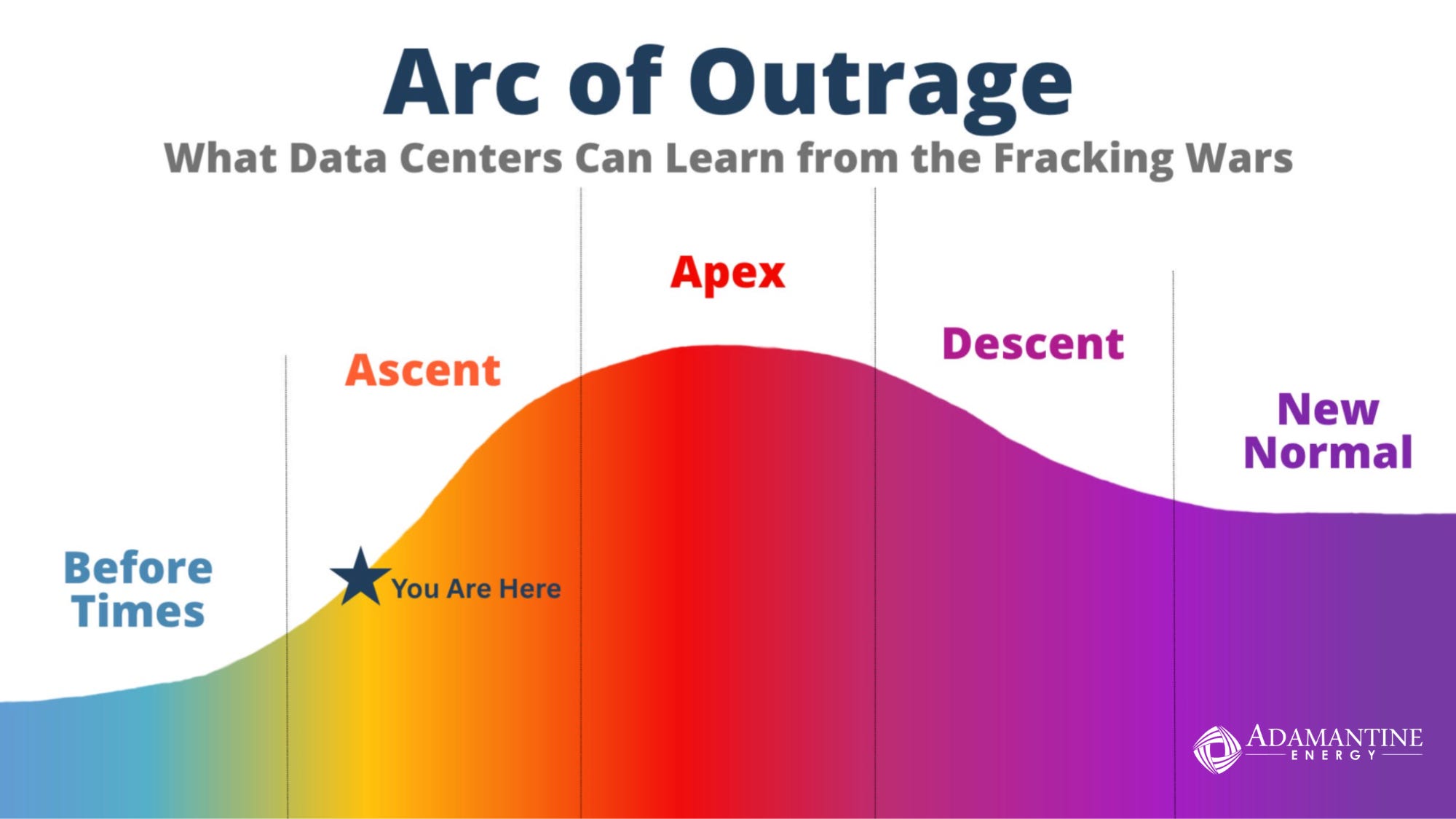
Welcome to the Arc of Outrage. In this series, I have been writing about the Arc coming for data centers, warned that facts and explainers will not stop it, and encouraged leaders to prepare for a longer, harder, more political fight than most companies are currently built to handle.
Data center proponents can learn a lot from the fracking wars and how those wars’ own Arc of Outrage played out—even though the arc for data centers won’t track 100 percent with fracking’s.
Too much bandwidth is being wasted on debating whether the two arcs will track. The debaters fall into two groups:
1. Data center skeptics who are certain that data centers will never be accepted by the public—despite the eventual (relative) acceptance of fracking
2. Data center developers who want to rationalize their “explainer” approach to opposition—and who are in denial that this is going to get a lot worse before it gets better
Let me just say to both groups: Yes, there are differences between the two arcs. But there’s only one that matters—and if you’re an infrastructure leader, you need to understand that difference and act on it to shorten and soften the Arc of Outrage this time around.
Both of these things are true:
Data centers are different from fracking in ways that matter.
Those differences make it more urgent, not less, for leaders to learn from the Arc.
The situation
Here are three observable differences between the fracking wars and the data center Arc:
Fracking was geographically concentrated where oil and gas resources were located and drilling and production were conducted. Data centers are more geographically dispersed.
The fracking politics on a national scale often shook out along party lines (but not as often as those outside of the fracking wars think—more on that below). Opposition to data centers seems to defy party identity.
The fracking culture wars got caught up in climate politics, particularly those of old energy versus new energy. Data center opposition is a mix of environmental and social concerns.
However: None of these really change the Arc of Outrage, nor how companies and communities should think about how to find solutions.
But there is one difference that really matters.
The difference that matters—and what that means for you
When I ran the Colorado Oil & Gas Association (COGA) during the fracking wars, I represented 40,000 oil and gas workers and their families—an awesome responsibility (in both meanings of the word).
To ground myself, I took my family on an annual road trip each of the five years I worked for COGA, going to all the oil and gas basins around the state. The first year, I was received as the “liberal from Boulder” by the local COGA chapters and chambers of commerce, who were understandably suspicious. My boys, ages 2 and 6 at the time, were irrepressible and irresistible. They climbed fences, raced down main streets, and asked to ride everything from cows to tractors. We went to barbecues, talks, tours, and local museums. Locals charmed us, and my boys charmed them. After five years of this, my boys (then 7 and 11) reasonably thought that the entire state of Colorado was their playground and every rancher a close personal friend.
My journey was different. I developed a deep and enduring respect for the identity of each place. The Piceance, Raton, DJ, and San Juan Basins varied wildly in their geology, geography, and history. At each location, there were local lore, fierce pride, generational feuds, and a unique sense of identity. Yet in the midst of the fracking wars, one thing connected all of these places: They were oil and gas country in a time when oil and gas country was under siege.
Data centers don’t have that connection with a place.
So, while some argue today that the fracking wars split sides between Democrats and Republicans, the truth is that there were plenty of Republican communities that opposed fracking in Colorado and around the country—they just weren’t in oil and gas country.
And even where oil and gas country was urban, the sense of being under siege brought groups together—groups that had a long history of bickering about other things. The historic feuds over water, property rights, recreation access, wildlife, environmental stewardship, development, and so on were set aside and a collective identity was formed: This is oil and gas country.
And so, as the head of COGA, I could mobilize this constituency—from car dealers to schoolteachers to grandmas. There were multigenerational mineral owners and multigenerational business owners. Thousands of people in any given community had a kid, neighbor, aunt, or cousin who worked in or around the oil and gas business—and being under siege meant they (we!) had to stick together.
Data centers don’t have that connection with generations and identity.
Yes, people rely on digital infrastructure. Many people use streaming services and online banking. Nearly all people use their phones for directions. All thanks to the invisible services enabled by data centers.
But I don’t know of any people who self-identify as “data center people.”
And I’ve never found myself in “data center country.”
That’s the starting point for your work if your project is going to survive and eventually transcend the Arc of Outrage.
Seize the day
Because there is no natural constituency for data centers, you will have to build one.
As data center opposition ascends the Arc, building that constituency is your long-haul task.
Do not misunderstand me: This is not a call for manufacturing fake support—communities can smell that as readily as the diesel fumes of a busload of “constituents” brought in for public comment. This is a call for considering how your project can be genuinely additive to the communities in and around your operations.
You are working to build a real constituency around shared value and values. That kind of work starts early and takes a long time. It is local and extremely bespoke. It is long-term because you are in this for the long haul.
You are no longer defending the idea of your project. You are creating the conditions in which your project can be defended by others—conditions that make your project theirs. This requires
Tangible, visible local benefits—valued by the community
Forged relationships between your operations leaders and local ones
Transparency about trade-offs—trade-offs managed by community priorities
Mitigation of those impacts that cannot be avoided, to the extent that they become acceptable as trade-offs
A commitment to long-term presence and engagement
In the end, it will be local leaders who take the heat for your project, and they can do so only when they can credibly demonstrate that your project makes the community better.
There are a few things you need to understand to take on this work:
Communities will be changed by a really large data center project.
How will that change be managed?
What are the processes to make course corrections as you go?
Are you transparently anticipating the effects on schools, traffic, housing, water, and land?
The benefits of data centers are more dispersed while the downsides are more locally acute.
How will you communicate about and actively mitigate local negative effects?
How can you ensure that the community and surrounding area share in the benefits?
Can you build a network of allies and beneficiaries through thoughtful project design?
The big question: Can you work with local leaders to design the project and community benefits in a way that contributes to generational improvement for that community?
The Arc of Outrage series
This Both True series is not about avoiding the Arc of Outrage—it’s too late for that. Data centers are industrial infrastructure with real local impacts, and communities are going to react. This series is about how to flatten the Arc, survive it, and, in the process, get important projects built. I will continue to bring you series installments in the months ahead.
Need help developing your Arc of Outrage strategy? Reach out for a briefing and tailored advice for your situation.

Forward this email to the people who need to get their teams moving.
Thanks for supporting my work! Please share and heart this piece.
It’s time to build the project that inspires a community’s interest,
Tisha
Secretive behavior in having community leaders and/or government officials signing NDA's and then presenting a project as inevitable don't help. Neither does reading about the profits made by officials who buy up the land to resell to the developers. The typical sales pitch about job creation for most infra projects is really a tale of construction cranes - the ratio of temp to permanent jobs is very low, and data centers are often managed remotely. The "benefits" of having CoPilot cramming down our throats and Meta setting up a system to allow its Facebook clients to steal other people's content from Instagram is a hard sell as well.
This debate was long overdue and it's past time for us to ask how much and what type of "tech" we really need to be paying for since the effort will be to distribute the higher costs of power across the rate base for some utilities.
And, time to ask whether the supposed endless supply of "abundant, affordable" natural gas will really materialize to support data center power projects, expanded LNG exports, power gen for the current customers, AND petrochemical feedstock demand in the not too distant future. The affordable part is likely to come under increasing pressure sooner rather than later, and choices will be made.
So true Anne. I believe somewhat the same way. There was no community pre-planning about these AI Data Centers, and how they would and could affect the community. There are always 2 sides ~ the good and the bad, and they should be discussed until hopefully a mutual agreement is made.